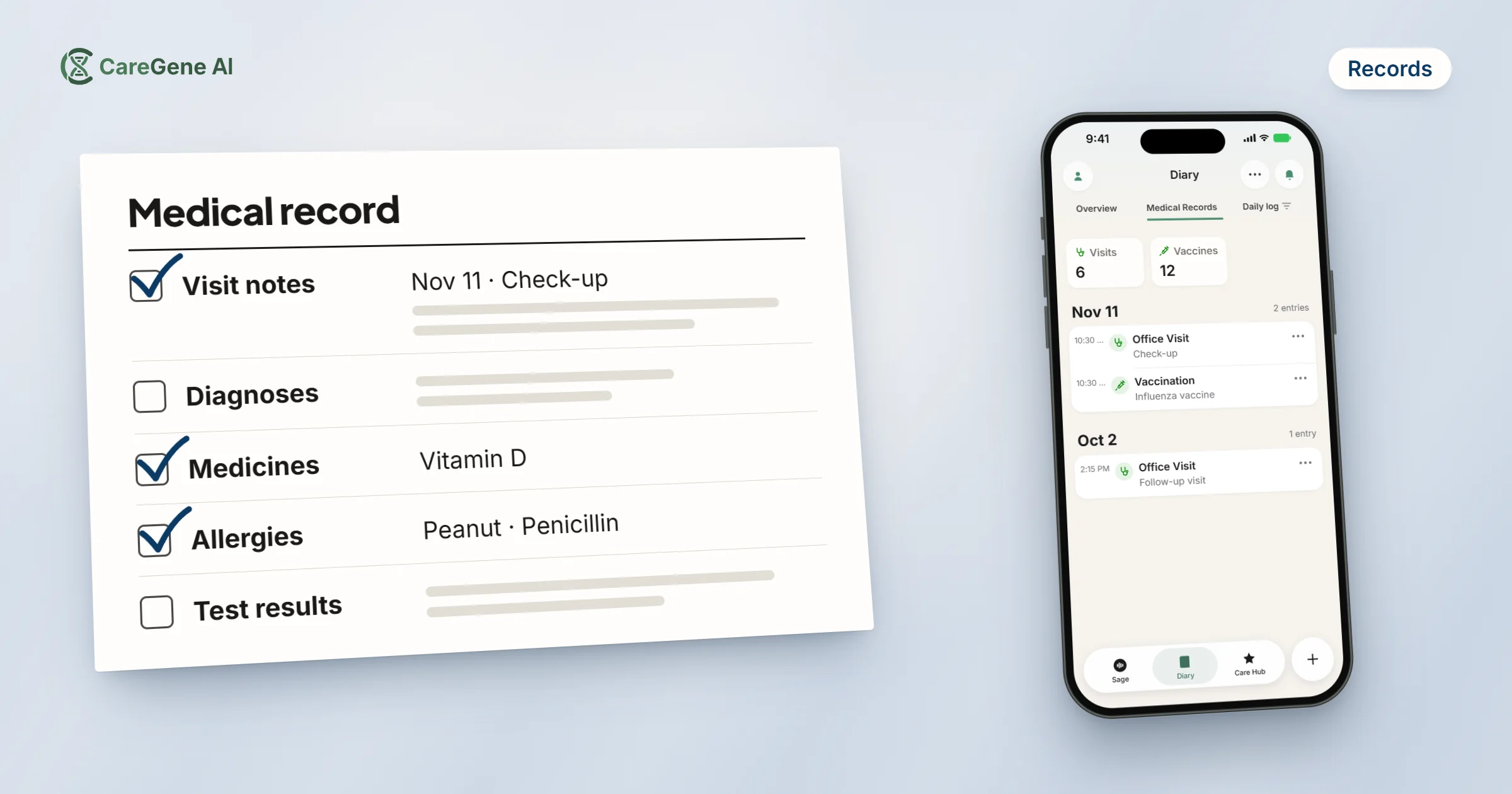

Short answer
Digital medical records are the electronic records that hospitals, clinics and other health care providers keep about a patient. HealthIT.gov calls an electronic health record (EHR) "a digital version of a patient's paper chart", with information such as diagnoses, medicines, allergies, immunization dates, test results and visit notes. Each office may keep its own record with its own process, so a child seen in many places may have many records, not one. Families can often read visit notes and test results in a patient portal, and results may appear before the doctor has seen them. HealthIT.gov suggests looking the record over to make sure it is "complete, correct, and up to date." If something is wrong, a federal rule lets you ask the provider to correct it. The provider may say no, and you can then respond in writing.
Key takeaways
- A digital medical record is the provider's record. Each hospital and clinic may keep its own, with its own process for getting a copy.
- The record holds diagnoses, medicines, allergies, immunizations, test results, images, visit notes and billing details. Start by checking the parts you know best.
- Families can often see visit notes and test results in a patient portal, sometimes before the doctor has seen them. Questions about what a result means go to the doctor who ordered the test.
- If something is wrong, contact the office of the provider who made the mistake. Under a federal rule, the provider has up to 60 days to act on a request, with one extension of up to 30 days.
- A provider may say no. You can then send a written statement explaining why you disagree.
What digital medical records are
HealthIT.gov describes an electronic health record (EHR) as "a digital version of a patient's paper chart" that "contains health information collected and maintained by healthcare providers over time." You will also see two terms used for these patient medical records:
- EMR (electronic medical record): "a digital version of the paper charts in the clinician's office", with "the medical and treatment history of the patients in one practice", according to a HealthIT.gov article.
- EHR (electronic health record): the same article says EHRs "are designed to reach out beyond the health organization that originally collects and compiles the information." HealthIT.gov says an EHR "can be created, managed, and consulted by authorized providers and staff across more than one healthcare organization."
This guide uses "digital medical records" for both. A record you keep yourself is a different thing, often called a personal health record; this guide is about the records providers keep.
Most families see these records through a patient portal. HealthIT.gov describes a patient portal as "a secure website, where patients can often do things like make appointments," and says the first step to getting your record is to check your provider's online patient portal, if they have one.
What is in a patient health record
HealthIT.gov says an EHR can "Contain information about a patient's medical history, diagnoses, medications, immunization dates, allergies, radiology images, and lab and test results," and lists "Progress notes, test results, and vital signs" among the typical parts. Each provider's portal shows these in its own way, so the names on your screen may differ.
Copy this table and use it when you read a record. Lines marked "Tip" are our own suggestions, not from a source.
| Part of the record | What it holds | What to look for | Source |
|---|---|---|---|
| Visit notes | Notes from each visit. KidsHealth says a note may hold the reason for the visit, symptoms, vital signs, the exam, test results, the diagnosis, the treatment plan and orders. | Tip: does the reason for the visit match what you remember? KidsHealth suggests calling the office about abbreviations you do not know. | 1, 13 |
| Diagnoses (conditions) | The conditions the provider has recorded. | Tip: is each one a condition a doctor has talked with you about? | 1 |
| Medicines | The medicines on record. | HealthIT.gov: check "what you take, how much, and when." | 1, 5 |
| Allergies | Known allergies. | HealthIT.gov lists allergies as something to check. | 1, 5 |
| Test results | Lab and other test results. | Tip: are the tests you know about there? What a result means is a question for the doctor who ordered it. | 1 |
| Immunizations | Immunization dates. | Tip: compare them with any vaccine record you keep at home. | 1 |
| Imaging | Radiology images. | Tip: are the scans you know about listed? | 1 |
| Contact details | Name, address, phone number and emergency contacts. | HealthIT.gov lists these as things to check. | 5 |
| Bills | Charges for care. | HealthIT.gov: "Make sure you're only being charged for services you've received." | 5 |
Why there is more than one record
HealthIT.gov puts it simply: "Every office may have its own system for record keeping." Its guide adds that "it can be a real challenge to get your health record if you've seen providers in different places," because "Each one may require you to follow a different process when asking for your health record."
So a child who sees a hospital team, several specialists and a local clinic may have a separate medical record file at each one. An EHR can be used across more than one organization, but that does not mean any one record holds a child's whole history. Getting copies from each provider is a topic of its own: see the question on getting copies in how to organize your child's medical records.
Reading visit notes and test results in the portal
KidsHealth, from Nemours, explains that "Part of the 21st Century Cures Act law aims to improve patient access to personal medical information." It also notes that "Clinical notes will vary depending on the provider, the type of visit and where your child receives medical care," and that "Deciding to read the notes is a personal decision."
Notes are not only from doctors. HealthIT.gov says the definition of electronic health information "does not specifically include or exclude notes or other clinical observations based on the type or specialty of the professional who authors them," so notes from nurses, pharmacists and other professionals count too.
Why results may appear before the doctor calls
HealthIT.gov says the federal rules "do not require" providers to post information on their own, but once a patient asks, they "must timely respond," and "Delays or other unnecessary impediments" could be a problem under the rules. In practice, it says, a patient may be able to see "test results in parallel to the availability of the test results to the ordering clinician."
Many hospitals now post results and notes as soon as they are ready. One health system (source 14) says "Almost all diagnostic test results and clinical notes, with rare exceptions, will be immediately released," that "you may see your results before your provider has seen them," and that "your provider will contact you for anything that needs follow up." Another (source 15) says a provider can "request a delay" in sending some results to the portal, and that you can tell your provider when a test is ordered if you would rather go over results such as genetics with the care team first. Ask your child's clinic whether you can choose this.
In one study of about 8,000 patients at four academic medical centers, described on HealthIT.gov, "95.7% of patients overall would like to continue to receive immediately released results." Patients with abnormal results were more likely to report worry. If a result raises a question, ask the doctor who ordered the test.
You may not see every note. HealthIT.gov says electronic health information leaves out psychotherapy notes and information gathered for a legal case, and other exceptions exist.
How to check digital health records
HealthIT.gov's guide for patients, called Get It, Check It, Use It, is also written for people acting for a minor child. Its "Check It" step is: "Find and fix mistakes in your health record." It suggests looking the record over "to make sure that all of your health information is complete, correct, and up to date," because mistakes or out-of-date information can "affect how your health care provider diagnoses and treats you."
A simple way to do it:
- Start with the provider's patient portal, if it has one.
- Go through the parts in the table above, starting with medicines, allergies and contact details, which HealthIT.gov names.
- Decide what matters. HealthIT.gov says small typos can be left or fixed, but errors that affect health or money are worth correcting.
- Write down what is wrong and where you saw it, and keep a copy of everything you send. (The first part is a tip; keeping copies is HealthIT.gov's advice.)
- Contact the provider's office and ask about its process for correcting a record. HealthIT.gov says to address your request "to the specific doctor or other provider who made the mistake."
Harvard Health Publishing says "Minor errors in medical notes are not rare," and "If you do see an important error that could affect your health, ask your provider to amend it." It adds that a doctor "can make clarifications or correct mistakes in an addendum at the end of the note." KidsHealth says that if something in a note looks wrong or surprising, contact the doctor's office: you may have misunderstood it, or the office may need to correct the record.
Asking a provider to correct the record
A federal rule (45 CFR 164.526) gives a person the right to ask a health care provider covered by the rule to amend, or correct, their record for as long as the provider keeps it. Here is how it works in general terms:
- How to ask: the provider may require the request in writing with a reason, but only if it tells people this in advance.
- How long it takes: the provider must act no later than 60 days after it receives the request. It may take one extension of up to 30 more days, with a written reason and a date, given within the first 60 days. These are outer limits in the federal rule.
- If the provider agrees: HealthIT.gov says it will update your record and send you a notice.
- When a provider can say no: for example, when it finds the record "accurate and complete," or when it did not create the information, unless the person who did is no longer available. That is one reason to send the request to the provider who made the mistake.
If the provider says no
HealthIT.gov says a denial notice should include "The reason they're not going to change the record" and "Information about how to respond to their decision." Under the federal rule, you can then:
- Send a statement of disagreement. The provider must let you submit a written statement saying why you disagree. It may reasonably limit the statement's length, and it may write a reply, which it must give you a copy of. When the provider later shares the part of the record you disputed, it must include your statement, or an accurate summary of it.
- Ask for your request to be kept with the record. HealthIT.gov says that instead of replying, you can ask the provider to include your request and its denial with the part of the record it affects.
- File a complaint. HealthIT.gov says you can file a complaint with the Department of Health and Human Services if you think the reason for the denial is wrong.
This is general information, not legal advice. For anything about your own case, ask the records office (health information management) at that hospital or clinic, including how a parent makes the request for a child.
For families of children with rare and complex conditions
Parents of children with rare and complex conditions, diagnosed or still looking for answers, often hold records from many providers. That makes one known weak point in digital records worth understanding.
The Agency for Healthcare Research and Quality (AHRQ) says "Copy-and-paste and other content import features can propagate incorrect, outdated, or improperly attributed information." In plain words, copied text can carry an error from one note to the next. An AHRQ article describes a wrong diagnosis that, once entered, "lived on in the EHR." Harvard Health Publishing says "it's easier than ever for health care providers to make (and perpetuate) errors in the medical record."
A regular look at the diagnoses, medicines and allergies in each record, for example after a hospital stay or a visit to a new specialist, is one way to find a copied error before it travels further. That is a tip, not a rule. If your child's diagnosis is new, the first 30 days after a diagnosis covers what to set up first.
Where CareGene fits
CareGene is an app built for parents of children with rare and complex conditions. In CareGene you can bring in records from participating hospitals.
Frequently asked questions
What are digital medical records?
They are the electronic records a hospital, clinic or other provider keeps about a patient. HealthIT.gov calls an electronic health record "a digital version of a patient's paper chart."
What is the difference between an EMR and an EHR?
A HealthIT.gov article describes an EMR as the digital chart of one practice, and an EHR as designed to reach beyond the organization that first collects the information. Many people use the two terms for the same thing.
Why does each hospital and clinic have a different record?
HealthIT.gov says every office may have its own system for record keeping, and each one may have its own process for requesting records. A child seen in many places may have a record at each one.
Can I see test results before the doctor calls?
Often, yes. At many hospitals results appear in the portal as soon as they are ready, which may be before the doctor has seen them. Ask the doctor who ordered the test about what a result means.
How do I ask for a mistake in a medical record to be corrected?
Contact the office of the provider who made the mistake and ask about its process. Under the federal rule, the provider has up to 60 days to act, with one extension of up to 30 days.
What if the provider says no?
The denial should give the reason and how to respond. You can send a written statement of disagreement, and when the provider later shares the disputed part of the record, it must include your statement or a summary of it.
Sources
- Assistant Secretary for Technology Policy / Office of the National Coordinator for Health IT (ASTP/ONC), HealthIT.gov. What Are Electronic Health Records (EHRs)? https://www.healthit.gov/topic/health-it-and-health-information-exchange-basics/what-are-electronic-health-records-ehrs (read 25 Nov 2026)
- ASTP/ONC, HealthIT.gov blog. EMR vs EHR: What is the Difference? https://www.healthit.gov/buzz-blog/electronic-health-and-medical-records/emr-vs-ehr-difference (read 25 Nov 2026)
- ASTP/ONC, HealthIT.gov. Get It, Check It, Use It: How to Get It. https://www.healthit.gov/how-to-get-your-health-record/get-it/ (read 25 Nov 2026)
- ASTP/ONC, HealthIT.gov. The Guide to Getting & Using Your Health Records. https://www.healthit.gov/how-to-get-your-health-record/ (read 25 Nov 2026)
- ASTP/ONC, HealthIT.gov. Get It, Check It, Use It: How to Check It. https://www.healthit.gov/how-to-get-your-health-record/check-it/ (read 25 Nov 2026)
- ASTP/ONC, HealthIT.gov. FAQ: Are actors (for example, health care providers) expected to release test results to patients through a patient portal ... https://healthit.gov/faq/are-actors-example-health-care-providers-expected-release-test-results-patients-through-patient/ (read 25 Nov 2026)
- ASTP/ONC, HealthIT.gov. FAQ: When information blocking is no longer limited to the subset that is represented by data elements in the United States Core Data for Interoperability (USCDI) ... https://healthit.gov/faq/when-information-blocking-no-longer-limited-subset-represented-data-elements-united-states-core/ (read 25 Nov 2026)
- ASTP/ONC, HealthIT.gov. FAQ: Are nursing, pharmacy, or other professions' clinical notes included in the definition of electronic health information? https://healthit.gov/faq/are-nursing-pharmacy-or-other-professions-clinical-notes-included-definition-electronic-health/ (read 25 Nov 2026)
- Code of Federal Regulations. 45 CFR 164.526, Amendment of protected health information (Cornell Legal Information Institute). https://www.law.cornell.edu/cfr/text/45/164.526 (read 25 Nov 2026)
- Agency for Healthcare Research and Quality (AHRQ) Patient Safety Network. Electronic Health Records. https://psnet.ahrq.gov/primer/electronic-health-records (read 25 Nov 2026)
- AHRQ Patient Safety Network. EHR Copy and Paste and Patient Safety. https://psnet.ahrq.gov/perspective/ehr-copy-and-paste-and-patient-safety (read 25 Nov 2026)
- Harvard Health Publishing. Ever read your medical record? Here's why you should. https://www.health.harvard.edu/blog/ever-read-your-medical-record-heres-why-you-should-202407083056 (read 25 Nov 2026)
- KidsHealth from Nemours. Viewing Clinical Notes in Your Child's Electronic Medical Record. https://kidshealth.org/en/parents/clinical-notes.html (read 25 Nov 2026)
- Dartmouth Health. Test Results: Cures Act. https://www.dartmouth-hitchcock.org/patients-visitors/test-results (read 25 Nov 2026)
- Duke Health. Receiving Electronic Health Information. https://www.dukehealth.org/curesact (read 25 Nov 2026)
- ASTP/ONC, HealthIT.gov blog. New study shows patients prefer immediate access to test results and have unmet information needs. https://healthit.gov/blog/information-blocking/new-study-shows-patients-prefer-immediate-access-to-test-results-and-have-unmet-information-needs/ (read 25 Nov 2026)
Last updated