
Short answer
A medical emergency card is a short card that tells a stranger or a responder what they need to know about your child in the first minutes: who your child is, their conditions, current medicines, allergies, communication or equipment needs, who to contact, and your child's doctor and preferred hospital. For a child with a rare or complex condition, it helps to pair the card with a fuller emergency information sheet, such as the Emergency Information Form from the American College of Emergency Physicians (ACEP) and the American Academy of Pediatrics (AAP), which you fill in with your child's doctor. Keep copies in your wallet, your car and your go-bag, give copies to the people who care for your child, and update them when anything changes. In an emergency, call your local emergency number.
Key takeaways
- The wallet card is short and written for strangers. The full emergency information sheet holds more, and your child's doctor completes it with you.
- Copy the template below, fill it in, print it, and keep it in a water-resistant bag.
- Give copies to everyone who cares for your child, and tell them where the card is kept.
- Keep sensitive numbers, such as a Social Security number, off the copies you hand out.
- Make a new card when medicines or doctors change, and review your copies on a regular schedule.
Two tools, two jobs
Parents of children with rare and complex conditions, diagnosed or still looking for answers, often hold information no one else has. An emergency is when that information has to reach someone fast, often someone who has never met your child. Two documents do that job in different ways.
The wallet card
The card is for the first minutes. The Connecticut Department of Public Health describes an emergency health information card as one that "communicates to rescuers what they need to know". It is short enough to read at a glance and small enough to carry everywhere. It is not a full history, and it is not where treatment instructions go.
The full emergency information sheet
The Emergency Information Form (EIF) from ACEP and the AAP is a longer form for children with special health care needs. ACEP describes it as a way to keep a child's complicated medical history summarized and available when it is needed most, and to pass critical information between doctors, parents, emergency medical services and nurses.
The EIF is not a form parents complete alone. The paper version ends with a line for the physician's or provider's signature, and the computerized version opens with "CONSENT REQUIRED". HealthyChildren.org, the AAP's site for parents, describes it as completed with the help of your pediatrician. A toolkit written by parents with emergency medical professionals, from Oregon's Family to Family Health Information Center, OHSU and Oregon EMSC, suggests talking with your child's doctor about whether your child needs the ACEP/AAP form or an emergency protocol letter.
Many families keep both: the card in a wallet, the sheet in the go-bag and with the people who care for their child.
A medical emergency card template you can copy
There is no PDF to download here. Copy the table into a document, fill in the last column, then print it, cut it down and fold it to wallet size. The fields come from the Connecticut card, the EIF, the Oregon toolkit and one state's childcare rule (sources 2, 4, 8 and 10). The "Last updated" row is our own suggestion.
| Field | What to write | Your child's details |
|---|---|---|
| Child's name | Full name | |
| Preferred name | The name your child answers to | |
| Date of birth | ||
| Conditions | Diagnoses or conditions, as your child's doctor has written them | |
| Current medicines | Names of what your child takes now | |
| Allergies | Medicines, foods and other substances | |
| Communication needs | How your child communicates and how others can help | |
| Equipment | Devices your child uses or needs with them | |
| Assistance needed | Help your child needs, in a few words | |
| Emergency contacts | Names and phone numbers of the people to call | |
| Child's doctor | Name and phone number | |
| Preferred hospital | The emergency department your child's care team expects you to use | |
| Last updated | The date you last checked the card |
For current medicines, copy from the list you already keep rather than writing it from memory. If you do not have one yet, how to keep track of your child's medications covers keeping a full list current.
Store the printed card in a water-resistant bag. HealthyChildren.org suggests this for printed copies of key information, and the CDC suggests a paper copy of your child's care plan in a waterproof bag.
What the full emergency information sheet adds
The computerized EIF is set out in six sections:
- Patient ID: who your child is.
- Facilities and providers: the doctors, pharmacy and hospital involved in your child's care.
- Clinical baseline: your child's usual medical picture.
- ED management: notes for the emergency department.
- Immunizations.
- Disaster planning and drills.
Inside those sections, the form has spaces for:
- Your child's name, birth date and primary language, the parent or guardian, and emergency contacts.
- Primary care, up to five specialists, your pharmacy and the emergency department you expect to use.
- The diagnoses or problem list, medicines with their doses and purpose, and devices your child relies on.
- Allergies, and medicines, foods or substances to be avoided and why.
- Procedures to be avoided and why.
- Comments on the child, family or other specific medical issues.
The medical parts are for your child's doctor to complete with you. Do not add treatment instructions of your own to the form or the card; those come from your child's doctor.
The sheet is different from the summary you bring to appointments. For keeping your child's full records and a summary for visits, see how to organize your child's medical records.
Who gets a copy, and where to keep it
HealthyChildren.org suggests keeping a copy of the emergency information form in your child's readiness kit and your car, and giving copies to others who care for your child. Those people might be a school nurse, a childcare provider, a babysitter or grandparents.
| Where | What to keep there | Source |
|---|---|---|
| Your wallet or bag | The card, or your child's prescription information | CDC; Connecticut Department of Public Health |
| Your car | The card and the sheet | HealthyChildren.org; CDC; Connecticut Department of Public Health |
| The go-bag or emergency kit | The sheet and a card | AAP; HealthyChildren.org; CDC |
| With your child | Identification to carry in case you are separated | CDC |
| Your phone or a USB drive | An electronic copy you can open offline | CDC |
| Others who care for your child | A copy of the card or sheet | HealthyChildren.org |
Ready.gov, writing for adults with disabilities, suggests telling your support network where you keep your emergency supplies. The same idea works here: tell the people on your contact list where the card and the sheet are.
The CDC also suggests involving your child's healthcare provider in your emergency plan and practicing the plan with your child.
Childcare emergency contact forms
Childcare programs often ask for their own emergency contact form, and your card and sheet make it quicker to fill in. As one example, a Pennsylvania child care rule (55 Pa. Code § 3280.124) requires emergency contact information for each enrolled child. It lists the child's name and birth date, the name, address and phone number of the child's physician or source of medical care, the parents' home and work addresses and phone numbers, written consent signed by a parent for emergency medical care, information on the child's special needs that is needed in an emergency, health insurance if applicable, and the people the child may be released to. Rules differ by state and type of program, so ask your program what its form needs.
What to leave off the copies you hand out
A card or a sitter sheet can be lost or left behind. Keep sensitive numbers, such as your child's Social Security number, off any copy you hand out, even though some sample cards online include one.
Keeping it current
Each source gives its own schedule, so it helps to know which is which:
- The CDC suggests updating medical and personal records at least once a year.
- HealthyChildren.org suggests reviewing the contents of your emergency kit at least every 6 months.
- The Pennsylvania childcare rule asks parents to update emergency contact information in writing once in a 6-month period, or as soon as the information changes.
Between those dates, a change in medicines, doctors or contacts means a new card. Replace every copy, including the ones at school, at childcare and in the car, and throw the old ones away so no one reads the wrong version.
Medical ID bracelets
If your child will wear one, HealthyChildren.org suggests considering a medical ID bracelet.
An emergency card in CareGene
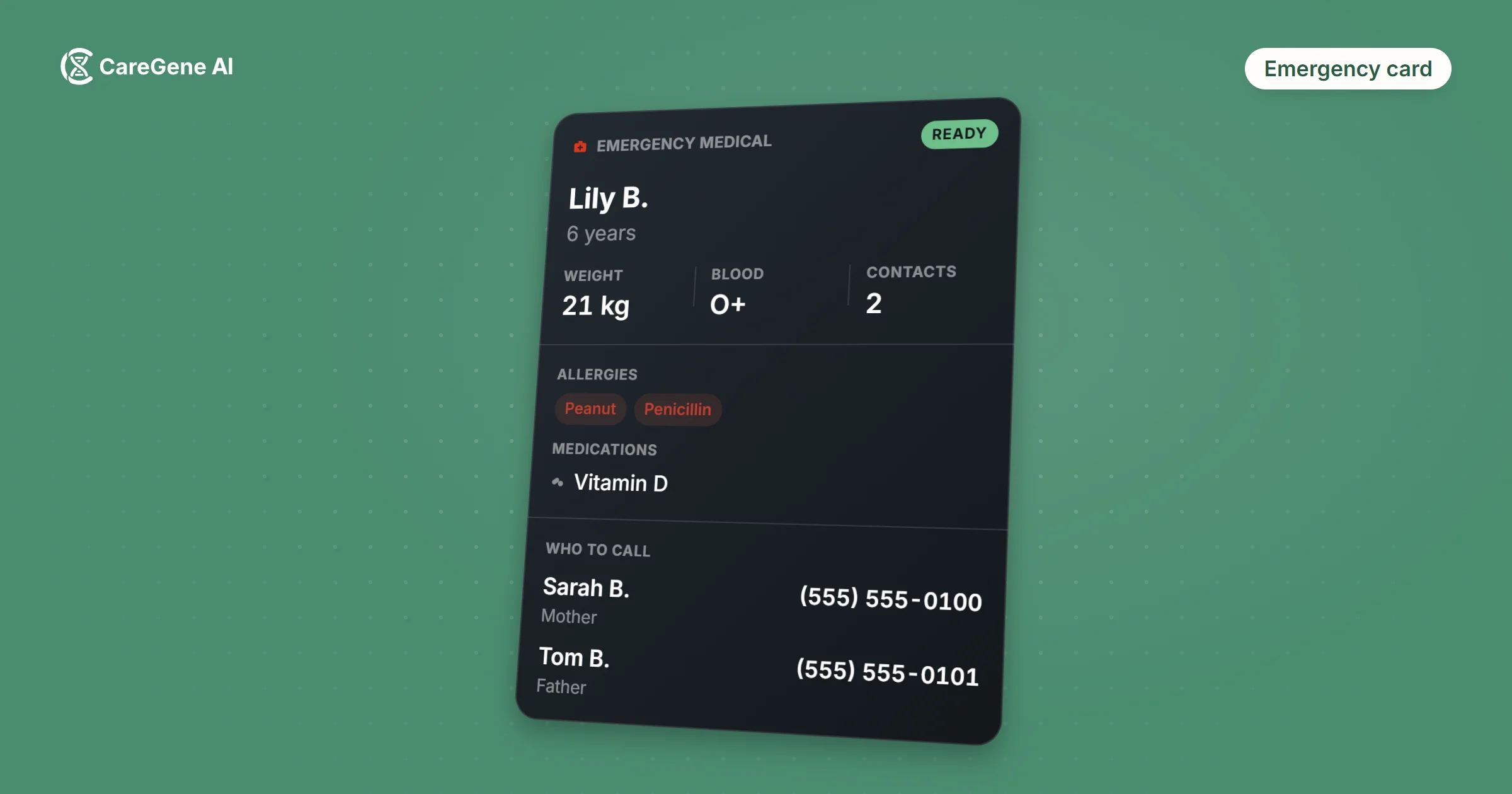
CareGene, an app built for parents of children with rare and complex conditions, has an emergency card with the essentials, and it works offline. Whatever you use, keep the form your child's doctor completes and the paper copies for the people who care for your child.
Frequently asked questions
What should go on a medical emergency card for a child?
Your child's name and preferred name, date of birth, conditions, current medicines, allergies, communication or equipment needs, emergency contacts, and your child's doctor and preferred hospital. Keep it short enough for a stranger to read at a glance.
Is there a printable emergency card template?
Yes. Copy the template table on this page into a document, fill it in, and print it. There is no PDF download here.
What is the Emergency Information Form?
It is a form from the American College of Emergency Physicians and the American Academy of Pediatrics for children with special health care needs. It holds more than a wallet card, and your child's doctor completes it with you.
What is the difference between an emergency card and an emergency info sheet?
The card is short and is for the first minutes with a stranger or responder. The info sheet, such as the Emergency Information Form, holds the fuller picture and is completed with your child's doctor.
Who should have a copy of my child's emergency card?
Keep copies in your wallet, your car and your go-bag, and give copies to others who care for your child, such as school, childcare, a babysitter and family. Tell them where the card is kept.
How often should I update my child's emergency information?
Whenever medicines, doctors or contacts change. Sources also give regular schedules: the CDC suggests updating records at least once a year, and HealthyChildren.org suggests reviewing your emergency kit at least every 6 months.
Have a question this guide didn't answer? Contact the team.
Sources
- American College of Emergency Physicians (ACEP). Emergency Information Form for Children With Special Health Care Needs. https://www.acep.org/patient-care/policy-statements/emergency-information-form-for-children-with-special-health-care-needs/ (read 23 Nov 2026)
- American College of Emergency Physicians (ACEP). Emergency Information Form For Children With Special Health Care Needs (computerized form, PDF). https://www.acep.org/siteassets/uploads/uploaded-files/acep/clinical-and-practice-management/resources/pediatrics/medical-forms/eifspecialneeds.pdf (read 23 Nov 2026)
- American Academy of Pediatrics (AAP). Emergency Preparedness for Children with Special Health Care Needs. https://www.aap.org/en/get-involved/aap-committees/committee-on-pediatric-emergency-medicine/emergency-preparedness-for-children-with-special-health-care-needs/ (read 23 Nov 2026)
- Oregon Family to Family Health Information Center, OHSU and Oregon EMSC. Planning for Health Emergencies: a toolkit for families of children with special health needs (PDF). https://www.ohsu.edu/sites/default/files/2025-10/EMSC%20Toolkit%20for%20Families_rev_10_25.pdf (read 23 Nov 2026)
- HealthyChildren.org (AAP). How to Build a Disaster Emergency Kit or "Go Bag" for Your Family. https://www.healthychildren.org/English/safety-prevention/at-home/Pages/Family-Disaster-Supplies-List.aspx (read 23 Nov 2026)
- Centers for Disease Control and Prevention (CDC). Emergency Medical Kit Checklist: Children with Special Healthcare Needs. https://www.cdc.gov/children-and-school-preparedness/special-healthcare-needs/emergency-medical-kit.html (read 23 Nov 2026)
- Centers for Disease Control and Prevention (CDC). Children and Youth with Special Healthcare Needs in Emergencies. https://www.cdc.gov/children-and-school-preparedness/special-healthcare-needs/index.html (read 23 Nov 2026)
- Connecticut Department of Public Health. Creating an Emergency Health Information Card. https://portal.ct.gov/dph/public-health-preparedness/bioterrorism/creating-an-emergency-health-information-card (read 23 Nov 2026)
- Ready.gov. People with Disabilities. https://www.ready.gov/disability (read 23 Nov 2026)
- Pennsylvania Code. 55 Pa. Code § 3280.124, Emergency contact information. https://www.pacodeandbulletin.gov/Display/pacode?file=/secure/pacode/data/055/chapter3280/s3280.124.html (read 23 Nov 2026)
Last updated