
Short answer
A personal health record (PHR) is a record of health information that you control and share with the people you choose, such as caregivers and family. A personal health record app keeps that record for you. It is different from the electronic health record your child's hospital or clinic keeps, which the provider controls; the hospital's patient portal is the provider's website, where you can often make appointments and get copies of records. To choose an app you can trust, check who can see the data and who the app shares it with, read its privacy notice, know that many consumer health apps are likely not covered by HIPAA, and check how records get in and how you can get them out again. As a parent, you usually have a federal right to a copy of your child's records, in electronic form when the provider can produce it, with exceptions for some care a minor can get alone.
Key takeaways
- You control a personal health record. The provider controls its own electronic health record and its patient portal.
- Before you choose an app, find out who can see your child's data and who the app shares it with, in plain words.
- Many consumer health apps are likely not covered by HIPAA. The FTC's Health Breach Notification Rule requires notice after a breach, and it does not approve apps.
- A parent who makes health care decisions for a child can usually ask for an electronic copy of the child's records, including to an app you choose.
- What a parent can see in a hospital portal often changes in the early teen years. Ask your child's clinic how theirs works.
What a personal health record is
The Centers for Medicare & Medicaid Services (CMS) describes a personal health record as one that "is controlled by the individual" and "can be shared with others, including caregivers, family members and providers." CMS adds: "This is different from a provider's electronic health record, which is controlled by the provider." A PHR "can help people track their health care services and better communicate with their providers."
Personal health record applications come from three places, according to CMS: health plans offer them to members, providers offer them to patients, and vendors offer them to anyone who chooses one.
How it differs from your hospital's patient portal
Many families first see their child's health records online through a patient portal. HealthIT.gov describes a patient portal as "a secure website, where patients can often do things like make appointments." In plain words, the portal is the provider's side: the hospital or clinic runs it and decides what it shows. A personal health record is your side: you decide what goes in and who sees it. Many parents use both.
If you are still setting up how you keep your child's records, how to organize your child's medical records compares a binder with an app and lists what to keep.
How to choose a personal health record app: what to look for
Copy this table and use it on any app you are considering, including a medical records app your health plan or hospital offers. Rows marked "Tip" are our own suggestions, not from a source.
| Question to ask | Why it matters | Source |
|---|---|---|
| Who can see my child's data, and who does the app share it with? | HealthIT.gov says it is important to make sure no one else can see your health information without your permission. | 3, 4 |
| Is there a privacy notice I can understand? | The FTC suggests looking for a privacy notice that "explains in simple terms what health information the app collects from you." | 4 |
| Does HIPAA apply to this app? | The FTC says many health apps "may not be covered by health privacy laws like HIPAA." | 4, 5 |
| What happens if my child's data is shared without my permission? | The FTC's Health Breach Notification Rule covers vendors of personal health records and makers of health apps, and requires notice after a breach. | 6 |
| How do my child's records get in? | You can ask a provider for an electronic copy, including to a health app of your choice. Some health plans must let you reach your data through an app you choose. | 2, 7, 9 |
| Can I get my child's data out again, for example as a download? | Tip: if you change apps, you will want to take the record with you. Ask before you start. | Tip |
| Can I share it with another parent or caregiver? | CMS says a PHR can be shared with caregivers and family members. Check that you choose who sees it. | 1 |
| What does it cost, and what happens to the data if I stop paying? | Tip: check the price and what happens to your data if you stop paying. | Tip |
Who can see the data
HealthIT.gov says it will be easier to share and manage your health information if you have an electronic copy of your health record. It also says it is important to make sure the place you keep it is secure, so that no one else can see your health information without your permission. Before choosing an app, HealthIT.gov suggests checking that it has a privacy policy you can read and that it will not use, sell or share your health information without your permission.
The FTC suggests comparing the privacy protections of similar apps, choosing the more protective settings, keeping the app updated, and reporting problems to the FTC.
When HIPAA does and does not apply
HIPAA is the federal health privacy law most parents have heard of, but it does not cover every app. The FTC says "the HIPAA Rules do not apply to health information maintained by anyone who isn't a covered entity or business associate." For an app that is not built on behalf of a covered entity, the FTC tells developers: "You likely are not covered by HIPAA."
That is why the question "who offers this app, and does HIPAA apply?" belongs on your list. If an app's own notice does not answer it, ask.
What the FTC Health Breach Notification Rule does
The FTC's Health Breach Notification Rule covers "a vendor of personal health records (PHRs)", and the FTC says "makers of health apps, connected devices, and similar products must comply with the Rule." The FTC says most health apps not covered by HIPAA are subject to the rule, "as long as they have the technical capacity to draw information from multiple sources."
Under the rule, a breach is not only a hack. It includes "a company's disclosure of covered information without a person's authorization." After a breach, notice must go out "without unreasonable delay" and "within 60 calendar days after the breach is discovered."
The rule is about telling people after a breach. It is not an approval of any app, so it does not replace your own checks.
Getting your child's records in
You can ask your child's provider for an electronic copy of their records. HealthIT.gov lists a "health app of your choice" as one way to receive it, and says "How you make your request will depend on your provider's processes." For the steps of asking each provider, see how to organize your child's medical records.
Some health plans must also let you reach your data through an app you choose. CMS's Patient Access API rule covers Medicare Advantage, Medicaid, the Children's Health Insurance Program (CHIP) and qualified health plans on the federal exchange. It lets a third-party app reach an enrollee's claims, encounter and clinical data. If your child's coverage is one of these, ask the plan how to connect an app. This rule is for health plans, not hospitals.
Medicare's Blue Button is one example of the idea: it lets a person link Medicare claims to apps they pick, and stop sharing at any time. Medicare advises: "Carefully review any apps or other services they offer before importing your data." It is for Medicare, so it is an example, not a children's program.
Your right, as a parent, to your child's records
Under the federal rule on access (45 CFR 164.524), a person "has a right of access to inspect and obtain a copy of protected health information about the individual." The copy is to be "in the electronic form and format requested by the individual" when it is readily producible, and if you ask, the provider "must provide the copy to the person designated by the individual."
For a child, a parent usually holds that right. The federal rule on personal representatives (45 CFR 164.502(g)) says that when a parent has authority to make health care decisions for an unemancipated minor, the provider "must treat such person as a personal representative," which means treating the parent as the child. The HealthIT.gov request form has a line for the "Signature of Patient or Personal Representative".
There are exceptions. They include care a minor can lawfully consent to alone, and care given under a confidentiality agreement. In those cases, whether a parent can see the records depends on what is "permitted or required by an applicable provision of State or other law." So a parent cannot always see everything. This guide is general information, not legal advice: for your child's case, ask the records office.
How long it takes, and what it costs
The rule says a provider must act "no later than 30 days after receipt of the request", with one 30-day extension allowed. HealthIT.gov says the same: "your health care provider can take up to 30 days to deliver your health record."
On cost, HealthIT.gov says: "Getting your records electronically, through a patient portal, health app, or by email, likely will be free." A reasonable fee may apply to copies.
When your child reaches the early teen years
Many hospital patient portals change what a parent can see as a child gets older, often around 12 or 13, depending on the hospital and your state. Ask your child's clinic how theirs works.
As one example, UR Medicine in Rochester, New York, says "only parents or legal guardians can request access" to a child's portal account, and that around the 12th birthday "your access will switch to 'limited.'" From 12 to 17, parents and legal guardians get limited access by default. For more, "your child must have their own" portal account "and approve your proxy request." For a child with diminished capacity, that health system says parents and legal guardians keep full access until 18. This is one health system's rule, not a national one.
The American Academy of Pediatrics (AAP) says "Individual state laws determine what information may be kept confidential," usually reproductive health, mental health and substance use care. The AAP also says that under federal law, "patients, including teens, must be able to access their electronic health records freely and easily."
If your child's portal access is about to change, it can help to keep your own copies of the records you rely on. That is a tip, not a rule.
For families of children with rare and complex conditions
Parents of children with rare and complex conditions, diagnosed or still looking for answers, often hold records from many places. The Maryland Department of Health made a care notebook for "the parents and caregivers of a child with special health care needs." It says "doctors and nurses rely on" parents "to give them information about your child's progress or your concerns," and the notebook puts "all the information parents need in one place and organized to find it easily."
The Maryland notebook can be saved on a computer or printed. Paper or digital, the point is the same: one place you control, kept current. If your child was diagnosed recently, the first 30 days after a diagnosis covers what to set up first.
Where CareGene fits
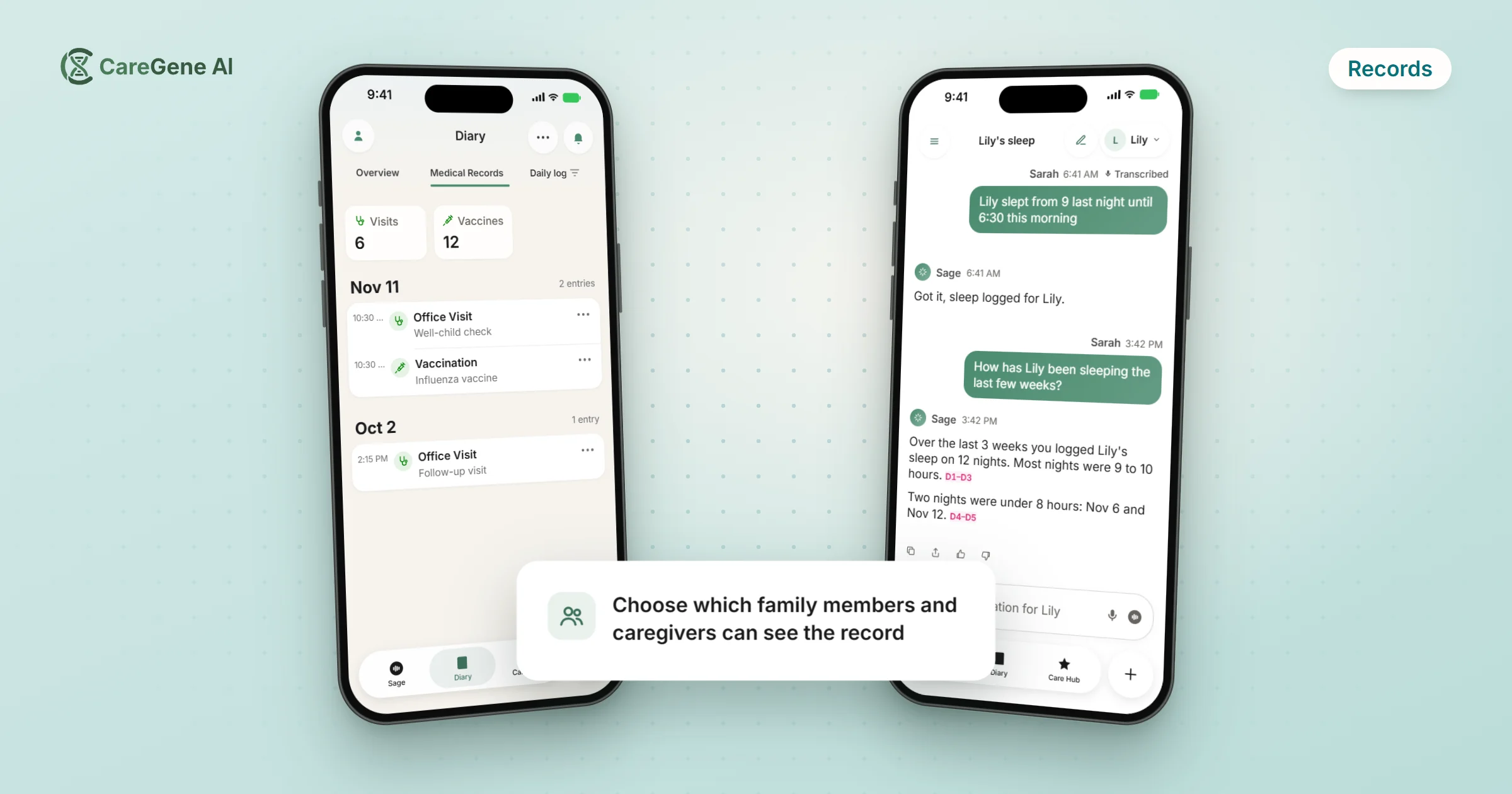
CareGene is an app built for parents of children with rare and complex conditions. In CareGene you can bring in records from participating hospitals, and choose which family members and caregivers can see the record. Run the checklist above on any app you consider, ours included.
Frequently asked questions
What is a personal health record app?
It is an app that keeps a personal health record: a record of health information that you control and share with the people you choose. CMS contrasts it with the provider's electronic health record, which the provider controls.
Is a hospital patient portal a personal health record?
Not in the CMS sense. The portal is run by the hospital or clinic, while a personal health record is controlled by you. Many families use both.
Are personal health record apps covered by HIPAA?
Often not. The FTC says health apps may not be covered by HIPAA, and an app not built on behalf of a covered entity is likely not covered. Ask who offers the app and read its privacy notice.
Can I put my child's hospital records into an app?
You can ask your child's provider for an electronic copy, and HealthIT.gov lists a health app of your choice as one way to receive it. How you ask depends on the provider's process.
How long does a provider have to send my child's records?
Under the federal rule, no later than 30 days after the request, with one 30-day extension allowed. HealthIT.gov says getting records electronically likely will be free.
Will I still see my child's portal when they become a teenager?
It depends on the hospital and your state. Access often changes around 12 or 13. Ask your child's clinic.
Have a question this guide didn't answer? Contact the team.
Sources
- Centers for Medicare & Medicaid Services (CMS). Personal Health Records. https://www.cms.gov/perhealthrecords/ (read 24 Nov 2026)
- Assistant Secretary for Technology Policy / Office of the National Coordinator for Health IT (ASTP/ONC), HealthIT.gov. Get It, Check It, Use It: How to Get It. https://www.healthit.gov/how-to-get-your-health-record/get-it/ (read 24 Nov 2026)
- ASTP/ONC, HealthIT.gov. Get It, Check It, Use It: How to Use It. https://www.healthit.gov/how-to-get-your-health-record/use-it/ (read 24 Nov 2026)
- Federal Trade Commission (FTC), Consumer Advice. Does your health app protect your sensitive info? https://consumer.ftc.gov/consumer-alerts/2021/01/does-your-health-app-protect-your-sensitive-info (read 24 Nov 2026)
- Federal Trade Commission (FTC), Business Guidance. Mobile Health App Interactive Tool. https://www.ftc.gov/business-guidance/resources/mobile-health-apps-interactive-tool (read 24 Nov 2026)
- Federal Trade Commission (FTC), Business Guidance. Complying with FTC's Health Breach Notification Rule. https://www.ftc.gov/business-guidance/resources/complying-ftcs-health-breach-notification-rule-0 (read 24 Nov 2026)
- Centers for Medicare & Medicaid Services (CMS). Patient Access API (frequently asked questions). https://www.cms.gov/priorities/key-initiatives/burden-reduction/interoperability/frequently-asked-questions/patient-access-api (read 24 Nov 2026)
- Medicare.gov (CMS). Share your Medicare claims. https://www.medicare.gov/providers-services/claims-appeals-complaints/claims/share-your-medicare-claims (read 24 Nov 2026)
- Code of Federal Regulations. 45 CFR 164.524, Access of individuals to protected health information (Cornell Legal Information Institute). https://www.law.cornell.edu/cfr/text/45/164.524 (read 24 Nov 2026)
- Code of Federal Regulations. 45 CFR 164.502(g), Personal representatives (Cornell Legal Information Institute). https://www.law.cornell.edu/cfr/text/45/164.502 (read 24 Nov 2026)
- American Academy of Pediatrics (AAP). American Academy of Pediatrics Supports Adolescent Right to Confidentiality With Use of Electronic Health Records. https://www.aap.org/en/news-room/news-releases/aap/2025/american-academy-of-pediatrics-supports-adolescent-right-to-confidentiality-with-use-of-electronic-health-records (read 24 Nov 2026)
- University of Rochester Medical Center (UR Medicine). How to Add Your Child to MyChart: A Step-by-Step Guide for Parents. https://www.urmc.rochester.edu/news/publications/health-matters/how-to-add-your-child-to-mychart-a-step-by-step-guide-for-parents (read 24 Nov 2026)
- Maryland Department of Health, Office of Children and Youth with Special Health Care Needs. My Health Care Notebook. https://health.maryland.gov/phpa/cyshcn/Pages/MyHealthcareNotebook.aspx (read 24 Nov 2026)
Last updated